
Observing and Recording Nature
Article and tutorial by Cassandra Barbosa
Happy journal prompt Friday! For this prompt, we are focusing on observing and recording nature or natural phenomenon. If you’ve joined us for the previous two prompts, you already know I love me some art… Below you will find the tutorial on how to observe and record nature. Take a walk and follow along with whatever peaks your interest. While I have your attention, let me tell you about what caught my eye- clouded sulphurs…
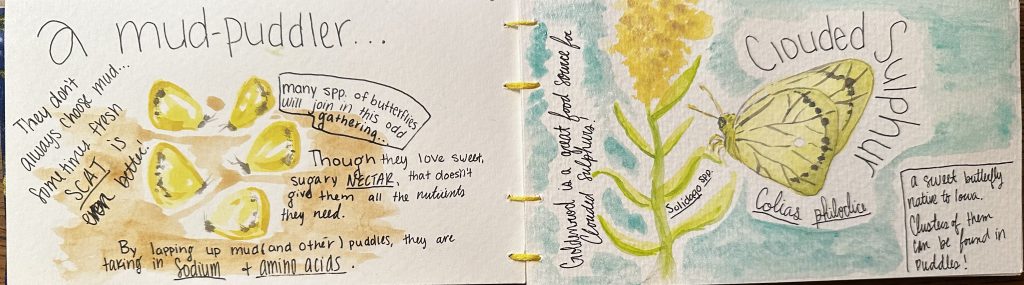
Clouded sulphurs (Colias philodice) are common pale yellow butterflies you see in open fields and parking lots. I stepped outside after a rain shower the other morning, and I felt like I was Dorothy in the Wizard of Oz. A twister of clouded sulphurs danced around me, spiraling up into the sky before they dispersed and landed on the damp gravel. There were hundreds of these yellow fellas scattering the driveway of the nature center. It seemed as if they preferred the bare dirt patches where tires had worn away the gravel. Why were they lapping up the damp earth instead of using the bird bath or a cleaner body of water? I claim to know everything, and despite my assertion, I had mere guesses as to why they were behaving this way… To the Internet we go! After searching trusted sources, I found the answer to my question.
Many butterflies partake in what’s called “mud-puddling”. It’s exactly what it sounds like, these butterflies gather around mud puddles and lap up the water. But why not clean water? Butterflies are a fantastic pollinator that drink mostly nectar, a sugar-filled liquid that flowers give critters who pollinate them. Much like you and I, butterflies need other nutrients and minerals besides sugar. From the damp earth, these clouded sulphurs were consuming sodium and crucial amino acids that they do not get from plants. After more research, I found that these beautiful butterflies are actually quite disgusting. Not only do they dine on the mineral-rich earth, but they love moist dropping from other animals. Recycling at its finest! Some butterflies that dine too much on the excrement from other critters get little butterfly tummy aches and propel liquid butterfly poop every three seconds. There is more science behind that, but I doubt you want to listen to me ramble about butterfly poop.
I encourage everyone to get curious about something that you witness often. Follow along with my tutorial and share your observations with us.
Below is the link to the PDF tutorial on observing and recording nature. I also have a few other links about clouded sulphurs, mud-puddling, and a link to the Wild Wonder Foundation website. Wild Wonder offers excellent nature journaling resources that I thoroughly enjoy, and I hope you do too…
Happy journaling,
Critter Cass